
AccelQ Alternatives in 2026: 6 Tools Compared by Authoring Model
AccelQ alternatives compared: Playwright, Katalon, BugRadar, testRigor, BrowserStack and Appium. Pricing, version control, and what codeless actually costs.
- Written by
- Yuvan Sundrani
- Read time
- 15 min read
- Published

TL;DR
- Playwright puts tests back in your repository under real version control, free.
- Katalon is the closest codeless swap, and it publishes its price.
- BugRadar is the one to look at when you want natural language with nothing stored.
- testRigor holds the plain-English line for non-technical authors.
- BrowserStack supplies devices and browsers rather than an authoring layer.
- Appium keeps mobile execution standards-based and portable.
AccelQ positions itself on its own site as codeless agentic testing across the entire tech stack, and the breadth is genuine: web, mobile, API, desktop and packaged applications including SAP and Salesforce under one platform.
Its pricing page offers a free trial and describes flexible plans, though every route to an actual number ends at Contact Us.
Breadth is the pitch. The question practitioners raise is what the codeless layer costs once a suite grows past a simple application.
Why move off AccelQ?
The most detailed account comes from someone whose company bought it. In a r/QualityAssurance thread on no-code automation, a tester wrote that the team was excited by the marketing and that in reality it was a total mess, then listed specifics: no version control, with no push action and no way to undo or redo changes after merging; smart element selection that worked on a small simple app and struggled on anything more complex; no community outside official support; and slow runs with micro-freezes as the no-code layer compiled into Java.
That is one team's experience rather than a verdict, and it is exactly the list to work through during a trial.
The pattern it describes is familiar enough to be a running joke. A r/softwaretesting post about automation vendor marketing sits at 204 votes, and the gap between demo and daily use is what it is laughing at.
Version control is the item worth dwelling on, because it is structural rather than a bug. Tests held inside a platform cannot be branched, reviewed in a pull request or reverted the way code can.
Here is the reframe worth holding onto: codeless removes the syntax and keeps the engineering problems, and version control is the one nobody budgets for.
| Tool | What it tests | Pricing | Best for |
|---|---|---|---|
| Playwright | Web (Chromium, Firefox, WebKit) | Free, Apache 2.0 | Tests under real version control |
| Katalon | Web, mobile, API, Windows desktop | Free tier, Professional $1,000/seat/yr | The closest codeless swap, priced publicly |
| BugRadar | iOS, Android and web | Per agent-run, self-serve trial | Natural language with nothing stored |
| testRigor | Web, mobile and API | Published tiers | Non-technical authors |
| BrowserStack | Web and mobile, 3,500+ real devices | From $29/mo | Device and browser coverage |
| Appium | Native iOS and Android | Free, Apache 2.0 | Portable, standards-based mobile |
1. Can Playwright replace AccelQ for web testing?
For the web surface, yes, and it answers the version control complaint completely, because a Playwright test is a file. It branches, it reviews in a pull request, it reverts, and it blames. Everything git does, your tests inherit.
Beyond that, one API covers Chromium, Firefox and WebKit with auto-waiting, network interception and native parallelism, across JavaScript, TypeScript, Python, Java and C#. Migration has also got easier: a r/Playwright post on using AI to move a thousand tests off Selenium in about an hour shows how much conversion work is now automatable.
Trace viewer is the other thing a platform dashboard was providing. It records each step of a failed run with a DOM snapshot, so CI failures stay diagnosable without a vendor UI in front of them.
Assembling several focused tools instead of one platform is the usual outcome, and it is a real cost in integration and reporting rather than a free win. Teams that make it work generally have one person who owns the pipeline end to end.
Pros: free, tests live in git with full history, cross-browser, five language bindings, auto-waiting removes a class of flake.
Cons: web only, so mobile, API, desktop and packaged applications all need separate answers, and someone has to write code.
Pricing: free, Apache 2.0.
Best for: teams whose objection is that tests live inside a platform.
2. Is Katalon a good AccelQ alternative?
Katalon is the nearest like-for-like codeless platform, with a GUI recorder, Object Spy and Groovy scripting over Selenium and Appium, covering web, mobile, API and Windows desktop.
Two differences matter against AccelQ. Katalon publishes its price, listing Professional at $1,000 per seat per year on its pricing page as a first-purchase offer against a $2,199 regular rate. And Groovy sits underneath the recorder, so a test that outgrows the GUI has somewhere to go rather than hitting a wall.
The community point matters here too. Katalon has a large public user base, so the answer to an odd error is usually a forum thread rather than a support ticket, which is the specific gap the AccelQ account described.
Version control sits in between the two models here. Katalon stores projects as files on disk that can go into git, which is closer to real history than a hosted platform offers, even if the GUI remains the primary way in.
Worth being clear that moving between two codeless platforms answers the pricing and community complaints while leaving the architectural ones untouched. A recorded test is still a recorded test.
Pros: free tier and a 30-day trial, published per-seat pricing, four surfaces, a scripting escape hatch under the recorder.
Cons: still selector-based, the free tier excludes parallel execution, and no SAP or mainframe depth.
Pricing: free tier, Professional listed at $1,000 per seat per year, Enterprise on an annual contract.
Best for: teams staying codeless who want transparency and an escape hatch.
3. Is BugRadar an AccelQ alternative with no stored tests?
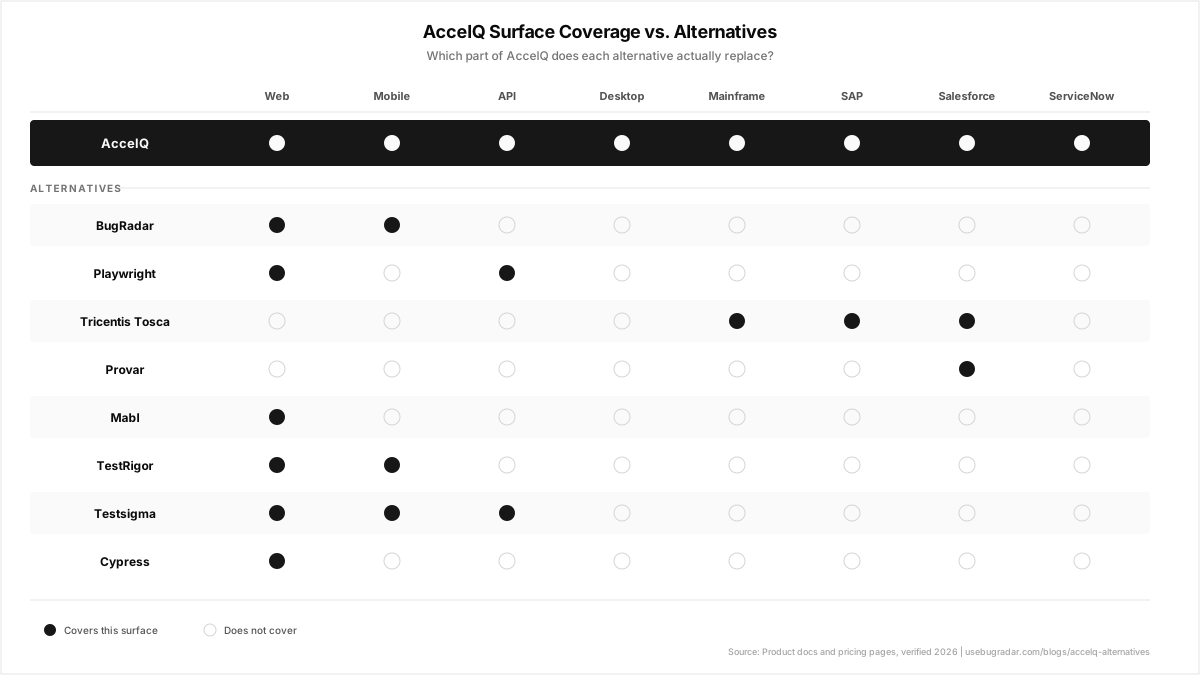
Here is the honest pivot. If you use AccelQ for SAP, Salesforce, mainframe or desktop applications, nothing on this list reaches those surfaces and you should keep it for them. A different group bought codeless to go faster and is now maintaining an artifact they cannot branch or revert.
BugRadar writes flows in natural language and runs them against the current interface rather than storing a script, which changes the version control question rather than answering it the same way: there is no captured artifact to version. For teams who do want files in git, the docs cover code-managed flows, where flow, suite and hook definitions live in your own repository and sync from there.
Coverage spans apps on virtual and physical iOS and Android devices and web across Chrome, Firefox, Edge and Chromium. The MCP server connects Claude Code, Cursor, Codex, Gemini CLI, Devin and Hermes Agent for flow management and running flows from the IDE, while the GitHub Bot analyses a pull request, runs the relevant flows and returns results with video.
On the performance complaint specifically, there is no compile step between authoring and execution here, because nothing is translated into another language before it runs.
Pros: no captured artifact to maintain, flow definitions can live in your own repository, mobile and web in one surface, per-run pricing, and a self-serve trial.
Cons: no SAP, Salesforce, mainframe, desktop or dedicated API testing, which is most of what AccelQ's breadth claim covers.
Pricing: per agent-run, self-serve.
Best for: teams using AccelQ for ordinary web and mobile rather than packaged applications.
4. Is testRigor an AccelQ alternative for non-technical testers?
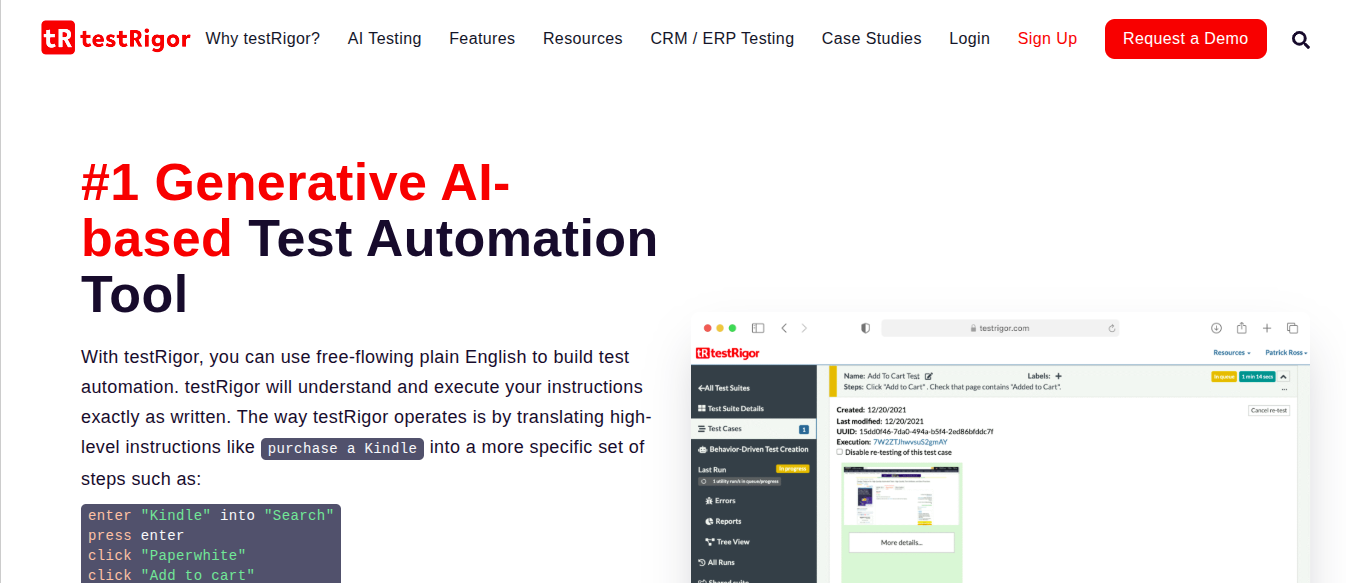
Where the codeless promise is the reason you bought AccelQ, testRigor keeps it and narrows the scope, taking plain English sentences across web, mobile and API, with email, SMS and API steps inside a single flow.
The structural objections travel with you, though. Tests still live in a vendor runtime rather than in git, so branching and review work the way the vendor allows rather than the way your engineers expect. Whether that trade is acceptable is the question a r/QualityAssurance thread on no-code tooling spends 45 comments arguing.
Email, SMS and API steps inside a single flow cover the login and one-time-code paths that usually force a codeless tool into a custom workaround, which is a practical reason it survives where simpler recorders do not.
One honest note on scope: this covers web, mobile and API, and leaves desktop, mainframe and packaged applications uncovered, so it narrows the platform rather than matching it.
Set against that, the authoring style genuinely lowers the barrier. A business analyst can write and read a test without translation, and on a team where the alternative is no automated coverage at all, that is the comparison that matters rather than the one against Playwright.
Pros: plain-English authoring with no code, web, mobile and API in one flow, built-in CI integrations.
Cons: proprietary runtime, no real version control story, and a small ecosystem next to Selenium or Playwright.
Pricing: published tiers.
Best for: teams whose authors will never write code.
5. Is BrowserStack an AccelQ alternative for device coverage?
Where the gap is browsers and handsets rather than authoring, BrowserStack addresses it directly with 3,500 real devices, Automate and App Automate for execution, Percy for visual regression, and Live for interactive sessions.
It replaces infrastructure rather than the codeless layer, so it pairs with Playwright or Appium instead of competing with them. Our BrowserStack alternatives guide compares the clouds.
Percy and Observability sit alongside for visual regression and flaky test detection, so some of what a consolidated platform promised arrives here as separate products you can adopt one at a time.
Pros: the broadest device and browser matrix, published pricing, mature support for every mainstream framework.
Cons: no authoring layer at all, so the codeless promise is not replaced here.
Pricing: from $29 a month, scaling with concurrency.
Best for: teams whose constraint is coverage.
6. Is Appium a free AccelQ alternative for mobile?
For the mobile half, Appium removes both the licence and the lock-in. It implements the W3C WebDriver specification in five languages and runs on any device cloud or your own hardware, so the suite travels with you.
It also answers the performance complaint in a blunt way: there is no no-code layer compiling into Java, because you wrote the Java. What you take on instead is device provisioning, driver rebuilds and flake management. Our Appium guide covers the setup path.
Portability is the underrated part. Because every major device cloud runs Appium natively, the same suite executes on a laptop, on a rented fleet, or on your own rack unchanged, which is the structural opposite of a platform-held test.
Teams that make this work usually have a platform engineer who owns the grid as a product rather than as a side task. Where that role exists the control is genuine, and where it does not the grid quietly becomes the flakiest part of the pipeline.
Pros: free, language-agnostic, standards-based, tests live in git, portable across every device cloud.
Cons: verbose configuration, iOS driver maintenance after OS releases, and no web, desktop or packaged-application coverage.
Pricing: free, Apache 2.0.
Best for: mobile teams who want control and portability.
Which AccelQ problem are you solving?
No version control. Playwright or Appium. Tests become files, and branching, review, revert and blame all come free with that rather than being features someone has to build.
Element selection failing on complex applications. BugRadar re-plans against the live interface rather than resolving a stored locator, which is a different mechanism rather than a better selector. Test it on your hardest screen rather than your cleanest one.
Slow runs and micro-freezes. Any code-first option removes the compile-from-no-code step entirely, and Playwright's parallelism is native rather than a licensed add-on.
No community to ask. Playwright, Appium and Selenium all have large public communities, which is worth more at two in the morning than a support ticket queued behind a business day.
Codeless authoring you want to keep. Katalon, which publishes its price and leaves a scripting escape hatch, or testRigor for plain English.
SAP, Salesforce, mainframe or desktop. Stay. Nothing on this list reaches those surfaces, and that breadth is the honest reason to keep AccelQ. A partial migration is usually the right shape: move the web and mobile suites, leave the packaged-application coverage where it already works.
Conclusion
AccelQ covers more surfaces than anything else on this list, and for a team genuinely testing SAP, Salesforce and mainframe alongside web and mobile, that consolidation is hard to replace piecemeal.
The complaints worth taking seriously are structural rather than cosmetic: tests that cannot be branched or reverted, element selection that strains on complex applications, and a compile step between authoring and execution. All three are testable in a trial, so run your most complex flows first rather than the demo-friendly ones, and ask how a test gets reverted before you ask how one gets written.
Frequently asked questions
What is AccelQ used for?
AccelQ is an enterprise codeless test automation platform covering web, mobile, API, desktop, mainframe, and packaged applications (SAP, Salesforce, ServiceNow, Workday, Oracle, MS Dynamics, Pega, Coupa). It targets large QA organizations in regulated industries that want business-process-focused automation without writing code.
What is the best free AccelQ alternative?
Playwright and Cypress are both free and open source. Playwright is the stronger option for cross-browser, multi-language teams. Testsigma's community edition is the best free codeless alternative if you want to keep a no-code authoring model without AccelQ's licensing.
Can BugRadar replace AccelQ?
For web and mobile E2E testing, yes. BugRadar eliminates the element model and codeless scenario layer entirely. It does not replace AccelQ for mainframe testing, SAP workflows, or packaged-app automation. If 60%+ of your AccelQ scope is web and mobile UI flows, BugRadar replaces that surface.
Is Playwright better than AccelQ for developer teams?
For engineering-led teams, yes. Playwright is free, tests live in version control alongside application code, and there is no abstraction layer. AccelQ is the better fit for non-technical QA teams in enterprise environments with packaged-app requirements and multi-surface breadth.
Does AccelQ have public pricing?
No. AccelQ uses a contact-sales pricing model with no public price points on the pricing page. On-premise deployment requires a minimum 10-license subscription. ACCELQ Cloud Lab (hosted execution for web and mobile) is quoted separately. A free trial is available via the site.
How do AccelQ and Tricentis Tosca compare?
Both use model-based test design for enterprise automation. AccelQ covers broader multi-channel surfaces (web, mobile, API, desktop, mainframe). Tosca has deeper SAP and Salesforce integrations. Tosca fits better in Tricentis-ecosystem enterprises. AccelQ fits better in multi-surface, platform-agnostic shops.
Which AccelQ alternative is best for mobile testing?
BugRadar for AI-native testing on real iOS and Android devices with intent-based flows and no element model. Testsigma for codeless mobile testing with open-source flexibility. TestRigor for plain-English mobile test authoring. Playwright covers mobile viewports but not native mobile apps.
Which AccelQ alternative works best with coding agents like Cursor and Claude Code?
BugRadar ships an MCP server that lets Cursor and Claude Code invoke test runs end-to-end against a PR. The agent runs flows, and session replay posts back to the PR automatically. AccelQ has not published an MCP integration as of 2026. No other tool on this list ships comparable coding-agent-native QA.