
AI Test Case Generation Tools in 2026: 9 Compared by What They Produce
Nine AI test case generation tools compared by output type: structured cases for review, executable tests for CI, and hybrid platforms. Honest reviews from practitioners.
- Written by
- Yuvan Sundrani
- Read time
- 15 min read
- Published

Two tools both claim "AI test case generation" but produce fundamentally different artifacts. Structured generators (TestCollab, Qase, TestRail) produce a document: test title, preconditions, steps, expected results. A human reviews and executes it. Executable generators (BugRadar, Keploy, GitHub Copilot) produce runnable code or flows that execute in CI without manual translation. Picking a tool before deciding which output your team needs is the most common mistake on the SERP. This guide groups nine tools by what they actually produce, with honest reviews of each.
Key Takeaways
- AI test case generation is the top AI application in QA. Roughly 89 percent of organizations are piloting or deploying generative AI in quality engineering, per the World Quality Report.
- The output format matters more than the generation method. Structured cases serve teams that need documented test plans for review. Executable flows serve teams that need regression testing coverage running on every PR.
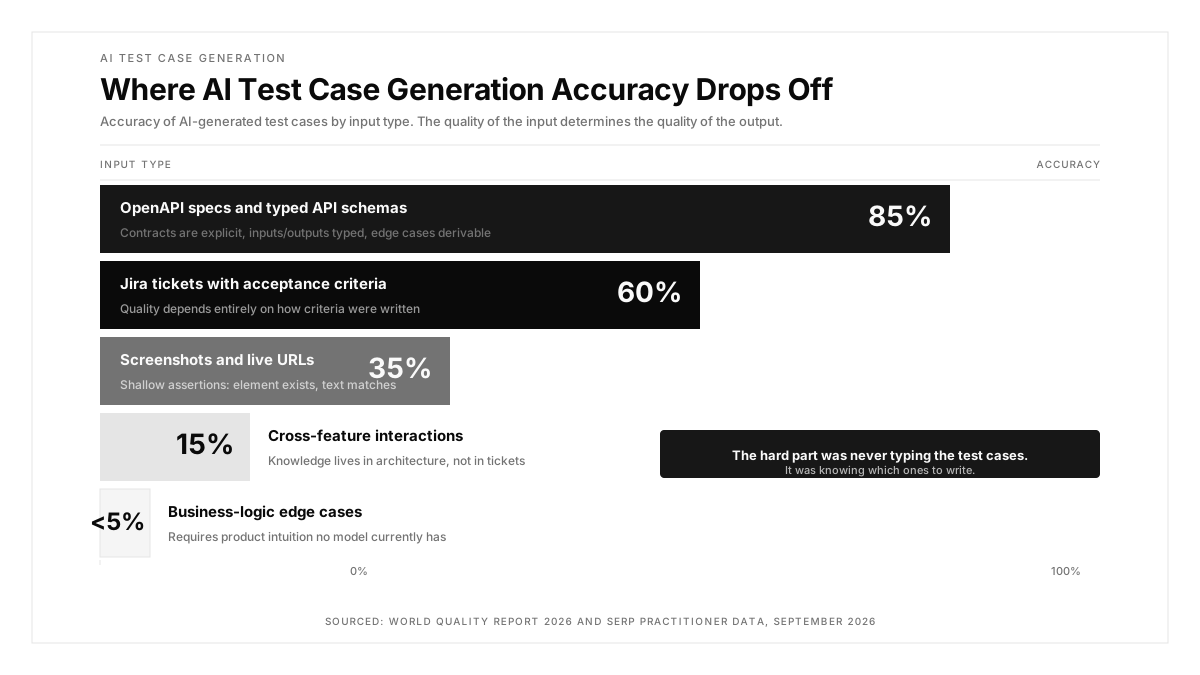
- AI-generated test cases reach up to 85 percent accuracy on well-documented features and drop sharply when requirements are vague. Quality of input determines quality of output.
- AI generates from what you give it. The bugs that reach production live in cross-feature interactions and edge cases the Jira ticket never mentioned. No current tool infers what the requirements leave out.
- BugRadar generates intent-based E2E flows from a description of what the user does, runs them across iOS, Android, and web on every PR, and self-heals when the UI changes.
Which AI test case generation tools are teams using in 2026?
| Tool | Category | Best For | Pricing |
|---|---|---|---|
| BugRadar | Executable E2E | Teams shipping iOS, Android, and web who want self-healing flows on every PR | Contact for pricing |
| TestCollab | Structured cases | QA teams needing generation, review, and management in one workflow | $39/user/mo |
| Qase | Structured cases | Modern test management with AI and developer workflows | $35/user/mo |
| TestRail | Structured cases | Established teams needing template-based generation and governance | From $420/seat/yr |
| Testsigma | Structured + agentic | Jira-centric teams moving from manual cases to automated execution | $8/user/mo |
| Keploy | Executable API | Developers generating API tests and mocks from real traffic | Free, open source |
| GitHub Copilot | Executable code | Developers wanting context-aware test suggestions inline in their editor | $10/mo individual |
| Katalon | Hybrid (manual + auto) | Mixed-skill teams combining test design with cross-platform automation | $59/seat/mo |
| BrowserStack | Hybrid (multi-format) | Teams with requirements in Jira, Figma, Confluence, and screenshots | Custom pricing |
Structured test case generators
These tools produce documents for human review: test title, preconditions, steps, expected results. The output lives in a test management platform. They solve the "I need 50 test cases for this feature by Friday" problem.
1. TestCollab: best for generation, review, and management in one workflow
Key features:
- Accepts prompts, Jira stories, requirements docs, screenshots, and URLs as input
- Generates both step-by-step cases and BDD-formatted scenarios mapped to requirements
- Generation, review, and execution tracking in one platform without switching tools
- Integrates with Jira for story-to-case traceability
Where it wins: A QA engineer on r/QualityAssurance described the practical workflow: "feed it the user story and acceptance criteria along with high-level test cases that I write, and it generates a decent Cucumber feature file. Never 100 percent spot-on, but close enough to save a lot of time. If you give it specific examples of existing tests as reference, it does a better job." Human-provided structure with AI-filled volume is where TestCollab delivers the most value.
Where it falls short: Generates structured cases, not executable automation. A human still translates the cases into Playwright or Appium scripts for regression. If your team needs tests that run in CI without manual translation, TestCollab covers the design phase only. Generation quality depends entirely on input: detailed acceptance criteria produce usable cases, vague Jira tickets produce vague tests.
2. Qase: best for modern test management with AI
Key features:
- AI-powered test case generation from requirements and prompts
- Clean, developer-friendly test management interface
- Integrations with GitHub, GitLab, and CI pipelines for reporting
- Lighter and more modern than TestRail with stronger developer workflows
Where it wins: Best option for teams that want test management first with AI generation as a built-in feature rather than a separate purchase. The interface is developer-oriented, which reduces friction for engineering teams managing their own QA. GitHub and GitLab integrations mean test results flow back to the PR without manual status updates.
Where it falls short: Management-first platform. AI generation is supplementary, not its core differentiator. Teams needing deep generation capabilities (multi-format inputs, visual element recognition, Figma or screenshot parsing) will find TestCollab or BrowserStack more capable. Pricing at $35 per user per month is mid-range for the category.
3. TestRail: best for enterprise template-based generation
Key features:
- Generates structured cases from requirements, user stories, and acceptance criteria
- Configurable templates for consistent output format
- Role-based access, audit trails, and traceability matrices for regulated industries
- Established default in enterprise test management
Where it wins: For organizations already using TestRail, AI generation is a natural add-on rather than a separate tool purchase. The governance features serve compliance-driven teams in finance, healthcare, and government where audit trails are mandatory.
Where it falls short: AI generation is incremental on top of an existing platform rather than purpose-built. Template-based approach produces consistent output but less creative coverage than tools that reason about requirements more deeply. Pricing starts at $420 per seat per year, which adds up for larger QA organizations. aqua and Testmo offer governance-focused generation at lower price points.
4. Testsigma: best for Jira-centric teams moving to automation
Key features:
- Accepts requirements and natural language to generate structured cases
- Converts generated cases into automated tests on its execution engine
- Jira integration pulls stories directly and maps test scenarios to tickets
- Most affordable option on this list at $8 per user per month
Where it wins: A practitioner on r/QualityAssurance described building this workflow from scratch: "built an agent to scrub through Jira for new features and read the acceptance criteria and come up with test scenarios," then feeding those into Playwright for execution. Testsigma automates that same pipeline as a product feature rather than a custom build.
Where it falls short: The agentic execution engine is newer and less mature than Playwright. Complex test logic and custom assertions can hit limits. The trade-off for affordability is depth of automation capabilities. Teams with complex multi-step flows may outgrow it.
Executable test generators
These tools produce runnable code or flows that execute in CI. They solve the "I need regression coverage that runs on every PR" problem.
5. BugRadar: best for cross-platform E2E flows
Key features:
- Generates intent-based E2E flows from plain-English descriptions
- Runs natively on iOS, Android, and web from a single flow definition
- Self-heals when UI changes between builds instead of failing on stale selectors
- Posts session replay to every PR via CI/CD integration
- Runs on real devices using Apple's XCTest APIs on iOS and Android instrumentation on Android
Where it wins: A senior engineer on r/QualityAssurance captured the core limitation of code-based generation: "AI writing tests based on code will just verify the code is doing what it was written to do. It won't verify correct business logic." BugRadar's intent-based approach generates from what the user does, not from the code that implements it. One flow definition replaces three platform-specific test suites.
Where it falls short: Does not produce structured test case documents. If your team needs formatted cases inside TestRail or Qase for compliance audits, traceability matrices, or manual sign-off workflows, BugRadar does not generate that artifact. Does not generate unit tests or API contract tests. The Gobi Maps case study shows where the approach fits.
6. Keploy: best for API test generation from traffic
Key features:
- Captures real API traffic and converts it into test suites with assertions and mocks
- Supports Go, JavaScript, and Python
- Generates tests from actual request-response pairs, not manual authoring
- Runs in CI alongside existing test frameworks
- Free and open source
Where it wins: Removes the manual authoring step entirely for API testing coverage. Point Keploy at your running application, and it generates tests from real traffic patterns. No schema or manual test writing required. The generated mocks also let you run tests without the actual backend, speeding up CI pipelines.
Where it falls short: Generates from observed traffic only, so unexercised endpoints and error handling paths need manual test cases. API-only: cannot generate UI or E2E tests. For teams needing API test authoring alongside documentation, Postman remains the standard.
7. GitHub Copilot: best for inline test code suggestions
Key features:
- Generates test code directly in the editor using surrounding code and test patterns as context
- Works in any framework: Jest, pytest, JUnit, XCTest, Espresso
- Follows conventions already established in the repository
- Available at $10 per month for individual developers
Where it wins: A DevOps engineer on r/devops described AI code tools on first trial: "it planned and worked with hundreds of files, found what it needs to do, and did it first try." GitHub Copilot generates boilerplate fast. Claude Code ($100-200/mo) offers deeper multi-file context for teams needing more than inline suggestions.
Where it falls short: Generates from the code, so it tests what the code does, not what the code should do. A practitioner on r/softwaretesting noted: bugs are found "significantly in the space of bugs outside the requirements. Automation and AI aren't covering that." Accelerates test writing but does not replace test design. Generates individual files, not coordinated regression suites.
Hybrid platforms
8. Katalon: best for mixed manual and automated testing
Key features:
- AI-powered generation of both structured cases and automated tests
- Cross-platform automation: web, mobile, API, and desktop in a single IDE
- Both codeless recorder and scripting support for mixed-skill teams
- Free tier available for small teams to evaluate
Where it wins: QA analysts design tests while SDETs automate them in the same platform, covering both workflows without switching tools. The free tier lowers the evaluation barrier, and the codeless recorder lets manual testers contribute automation without writing scripts.
Where it falls short: All-in-one approach means not best-in-class at any single function. TestCollab has deeper test management. Playwright has faster web automation. Keploy has better API generation from traffic. At $59 per seat per month, the price adds up for larger teams.
9. BrowserStack: best for multi-format requirement inputs
Key features:
- Accepts prompts, uploaded files, images, Jira tickets, Figma designs, and Confluence pages
- Generates structured cases and BDD scenarios
- Option to run generated tests on 3,500+ real devices
- Widest range of input formats for AI generation
Where it wins: For teams with requirements scattered across formats (Figma, Confluence, Jira, screenshots), BrowserStack reduces the input preparation step that other tools require. Direct path from generation to real device execution means generated cases can run against 3,500+ devices without leaving the platform.
Where it falls short: Primarily device infrastructure. AI generation features are newer and less mature than dedicated generators like TestCollab or Qase. Pricing is enterprise-oriented and tied to the broader BrowserStack platform. Teams needing generation without cloud device execution are paying for infrastructure they may not use.
How do you pick the right AI test case generation tool?
Three questions narrow the field.
What output do you need? Structured cases for human review and manual execution: TestCollab, Qase, or TestRail. Executable tests that run in CI: BugRadar (E2E), Keploy (API), or GitHub Copilot (unit and integration). Both: Katalon, Testsigma, or BrowserStack. This single question eliminates half the candidates.
What inputs do you have? OpenAPI specs and typed API schemas produce the best generated output (Keploy). Jira tickets with detailed acceptance criteria produce moderate output (TestCollab, Testsigma, Qase). Screenshots and Figma designs produce shallow assertions (BrowserStack). Code context produces targeted but implementation-bound output (GitHub Copilot). Match the tool to your strongest available input.
Who will review and maintain the output? AI-generated test cases are first drafts, not finished artifacts. A QA engineer on r/QualityAssurance was blunt: "AI can't write test cases for me because it doesn't know our product. We hardly know our product." Structured generators need a human reviewer. Executable generators need a human to validate assertions. Self-healing tools (BugRadar) reduce ongoing maintenance but still need human judgment on which flows to generate.
Conclusion
AI test case generation tools accelerate the drafting phase of test design. They do not replace the judgment that decides what is worth testing. Start by deciding what output you need (structured cases or executable tests), match the tool to your strongest available input, and treat every generated case as a first draft. The tools that generate noise are easy to spot: they confirm what you already know instead of surfacing what you do not.
FAQ
Can AI generate test cases from Jira tickets?
Yes. TestCollab, Testsigma, Katalon, and BrowserStack accept Jira tickets as input. Output quality depends on how detailed the acceptance criteria are. Vague tickets produce vague tests.
What is the best free AI test case generation tool?
Keploy offers free API test generation from traffic and OpenAPI specs. GitHub Copilot has a free tier for individual developers. Testsigma starts at $8/user/mo with AI generation included.
How accurate are AI-generated test cases?
Up to 85 percent on features with clear, detailed requirements. Accuracy drops on poorly documented features, cross-feature interactions, and edge cases. Always treat generated output as a first draft requiring human review.
Can AI test case generation replace manual testers?
Not for exploratory testing, domain judgment, or cross-feature validation. AI accelerates the scripted portion of test design. The Gobi Maps case study shows how teams use AI for regression while humans own strategy.
Do AI test case generation tools work for mobile apps?
Most generate platform-agnostic structured cases that need manual translation to native frameworks. BugRadar generates executable mobile flows natively. Katalon and Testsigma support mobile through dedicated modules.
What inputs produce the best AI-generated test cases?
OpenAPI specs and typed API schemas produce the highest quality. Jira tickets with acceptance criteria produce moderate quality. Screenshots produce shallow assertions. Code diffs produce targeted regression cases.
How long does AI test case generation save per feature?
Industry data shows 40 to 60 percent reduction in test design time, reducing average time per test case from roughly one hour to nineteen minutes. Savings depend on input quality and tool choice.
Is AI test case generation reliable enough for regulated industries?
Structured generators like TestRail and aqua provide audit trails, traceability matrices, and human review workflows. The AI generates a draft; a human approves it. Manual testing remains part of the compliance process.