
7 testRigor Alternatives in 2026, Compared by Authoring Model
testRigor alternatives compared: Playwright, Katalon, BugRadar, Cypress, BrowserStack, Appium and Mabl. Pricing, lock-in, and what plain English actually costs.
- Written by
- Yuvan Sundrani
- Read time
- 14 min read
- Published

TL;DR
- Playwright is the standard answer where your testers can code, free and in five languages.
- Katalon keeps a visual recorder and publishes its price.
- BugRadar is the one to look at when you want natural language with nothing stored.
- Cypress suits JavaScript teams who want time-travel debugging.
- BrowserStack supplies devices and browsers rather than an authoring layer.
- Appium keeps mobile execution standards-based and portable.
- Mabl offers low-code authoring with machine-learning healing.
testRigor's own site sets out an unusually wide surface for a plain-English tool: web, mobile, desktop and mainframe testing, accessibility, 21 CFR Part 11 compliance, and AI-based self-healing, with a documented feature for working alongside Claude Code.
Its pricing page publishes no figures, so the number arrives through a conversation.
The authoring idea is genuinely appealing. The argument is about what sits underneath it.
Why move off testRigor?
The clearest framing came from a practitioner rather than a competitor. In a r/QualityAssurance thread comparing testRigor with Playwright, a reply at 11 votes, more than the thread itself, put the decision like this:
Testrigor is a 100% no code testing framework. Playwright is coded. Any comparison is silly. If you have automators as QA, use Playwright because it's better in almost every way. If you don't have any technical testers, use test rigor. Or hire some and use Playwright.
That is fair to both tools, and it reframes the question as a staffing decision rather than a feature comparison.
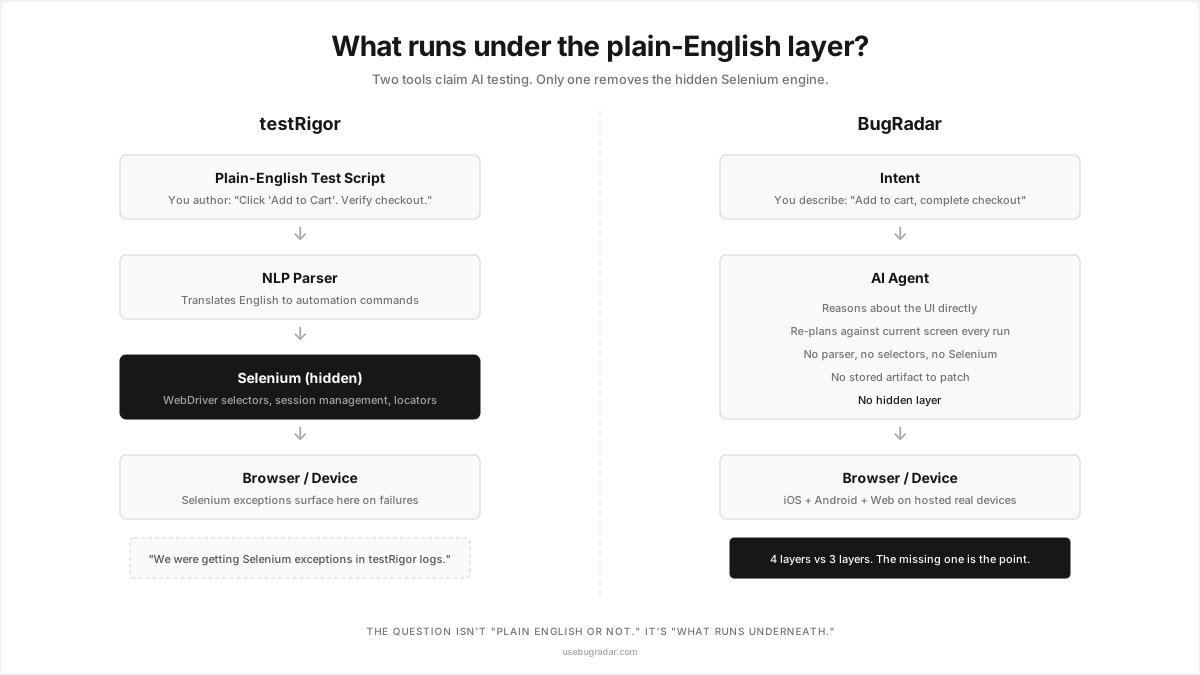
The second objection is where the tests live. Plain English runs inside testRigor's own runtime, so there is no file to branch, review in a pull request or revert, and the exit cost grows with every test you add.
The third is sentiment about the category rather than this product alone. A r/QualityAssurance thread asking why engineers prefer Playwright, Selenium or Cypress to codeless tools drew 37 votes and 46 comments, and a separate thread on whether no-code tooling has matured carries 45 more.
Here is the reframe worth holding onto: plain English is a hiring decision disguised as a tooling decision.
| Tool | What it tests | Pricing | Best for |
|---|---|---|---|
| Playwright | Web (Chromium, Firefox, WebKit) | Free, Apache 2.0 | Teams whose testers can code |
| Katalon | Web, mobile, API, Windows desktop | Free tier, Professional $1,000/seat/yr | A visual recorder with published pricing |
| BugRadar | iOS, Android and web | Per agent-run, self-serve trial | Natural language with nothing stored |
| Cypress | Web (Chromium-based, Firefox) | Free runner, Cloud paid | Front-end debugging experience |
| BrowserStack | Web and mobile, 3,500+ real devices | From $29/mo | Device and browser coverage |
| Appium | Native iOS and Android | Free, Apache 2.0 | Portable, standards-based mobile |
| Mabl | Web, mobile, API, accessibility, performance | Request a quote | Low-code with ML healing |
1. Is Playwright a good testRigor alternative?
Playwright is the destination that comment points at, and the case is strong wherever your testers write code. One API covers Chromium, Firefox and WebKit with auto-waiting, network interception and native parallelism, across JavaScript, TypeScript, Python, Java and C#, and the tests are files in your repository with full git history behind them.
The standard objection is that non-technical testers cannot use it. That deserves evidence: a r/Playwright post from someone who entered QA from a non-technical background specifically through Playwright drew 49 votes and 27 comments describing how long the ramp actually took.
Trace viewer matters for anyone leaving a hosted runtime. It records every step of a failed run with a DOM snapshot, so the diagnostic surface a vendor dashboard provided arrives free and runs locally.
Assembling several focused tools rather than buying one platform is the usual outcome, and the integration and reporting work is a genuine cost rather than a free win.
Pros: free, tests live in git with branching and revert, cross-browser, five language bindings, auto-waiting removes a class of flake.
Cons: web only, so mobile, desktop and mainframe all need separate answers, and someone has to write code.
Pricing: free, Apache 2.0.
Best for: teams who have automators, or intend to hire them.
2. Is Katalon a good testRigor alternative?
Where the plain-English layer exists because your authors will not write code, Katalon keeps that constraint and changes the mechanism, offering a GUI recorder and Object Spy over Selenium and Appium, covering web, mobile, API and Windows desktop.
Two practical differences. Katalon publishes its price, listing Professional at $1,000 per seat per year on its pricing page as a first-purchase offer against a $2,199 regular rate. And Groovy sits underneath, so a test that outgrows the recorder has somewhere to go.
Katalon stores projects as files on disk, which is closer to real version history than a hosted runtime allows, even though the GUI stays the primary way in. For a team whose objection is ownership rather than syntax, that difference is the point.
The community point matters too. Katalon has a large public user base, so an odd error usually resolves through a forum thread rather than a support ticket, which is worth more during an incident than a service-level agreement.
Pros: free tier and a 30-day trial, published per-seat pricing, four surfaces, a scripting escape hatch.
Cons: selector-based underneath, the free tier excludes parallel execution, and no mainframe coverage.
Pricing: free tier, Professional listed at $1,000 per seat per year, Enterprise on an annual contract.
Best for: non-coding authors who want transparency and a way out.
3. Is BugRadar a testRigor alternative with no stored tests?
Here is the honest pivot. If your testers can code, Playwright beats everything here on freedom and cost, and you should take it. If you need mainframe or 21 CFR Part 11 coverage, testRigor's own site lists those and nothing on this list matches them. A third group wants plain language without a vendor holding the tests.
BugRadar writes flows in natural language and runs them against the current interface rather than storing a script. For teams who want files in git, the docs cover code-managed flows, where flow, suite and hook definitions live in your own repository and sync from there, which is the specific thing a vendor runtime cannot offer.
Coverage spans apps on virtual and physical iOS and Android devices and web across Chrome, Firefox, Edge and Chromium. The MCP server connects Claude Code, Cursor, Codex, Gemini CLI, Devin and Hermes Agent for flow management and running flows from the IDE, while the GitHub Bot analyses a pull request, runs the relevant flows and returns results with video.
Healthy scepticism belongs in any trial of this category. A r/softwaretesting thread titled "AI is a nightmare for QA" carries 174 votes and 108 comments of it.
The practical test during a trial is simple: ask how a test gets reverted after a bad change, and whether that answer involves your version control or the vendor's interface.
Coverage honesty matters here: this reaches web and both mobile platforms and stops there, so it narrows testRigor's surface rather than matching it.
Pros: natural language with no stored artifact, flow definitions can live in your own repository, mobile and web in one surface, per-run pricing, and a self-serve trial.
Cons: no desktop, mainframe or 21 CFR Part 11 coverage, and no dedicated accessibility scoring.
Pricing: per agent-run, self-serve.
Best for: teams who want the authoring style without the runtime lock-in.
4. Can Cypress replace testRigor for front-end testing?
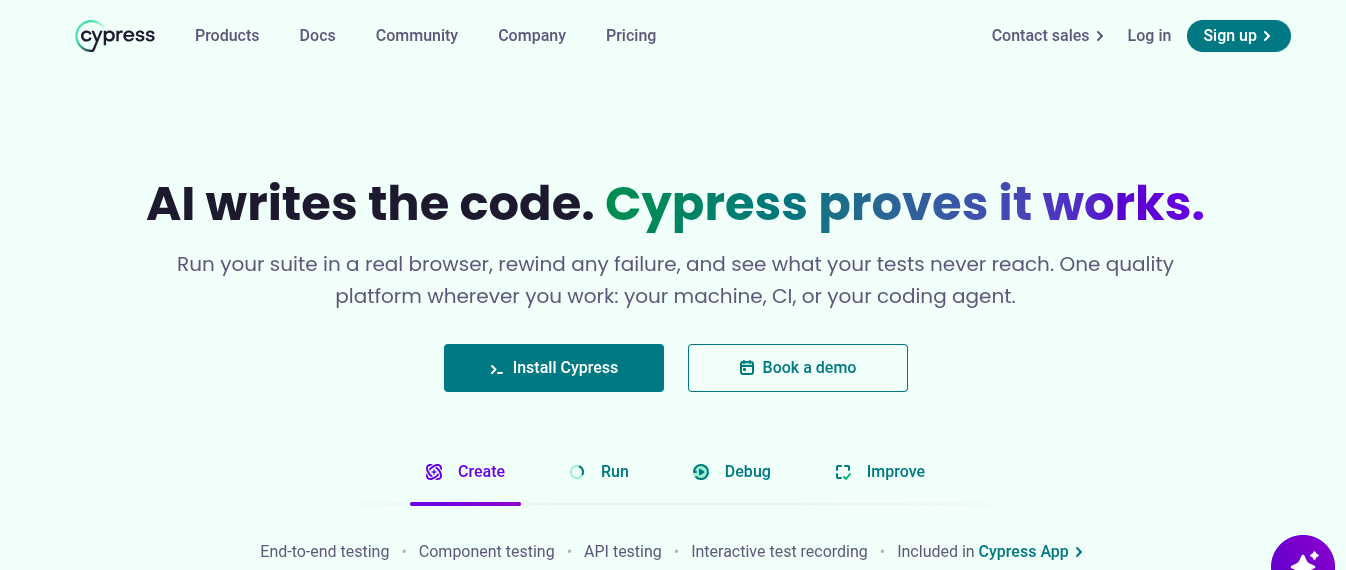
Cypress runs inside the browser event loop, producing a DOM snapshot at every step and the time-travel debugging that makes a failing assertion quick to diagnose. Against a plain-English tool the trade is explicit: you require JavaScript knowledge and gain a debugging loop a vendor runtime cannot match.
Worth naming the scope boundary plainly: Cypress tests the web in JavaScript, so a team using testRigor for mobile or desktop covers a fraction of its surface here and needs a second answer for the rest.
Pros: the best debugging experience in the category, automatic waiting for DOM stability, first-class TypeScript support, strong plugin ecosystem.
Cons: JavaScript and TypeScript alone, no mobile, desktop or mainframe, and parallel runs need the paid Cloud tier.
Pricing: free runner under MIT, with Cypress Cloud paid.
Best for: JavaScript teams testing single-page applications.
5. Is BrowserStack a testRigor alternative for device coverage?
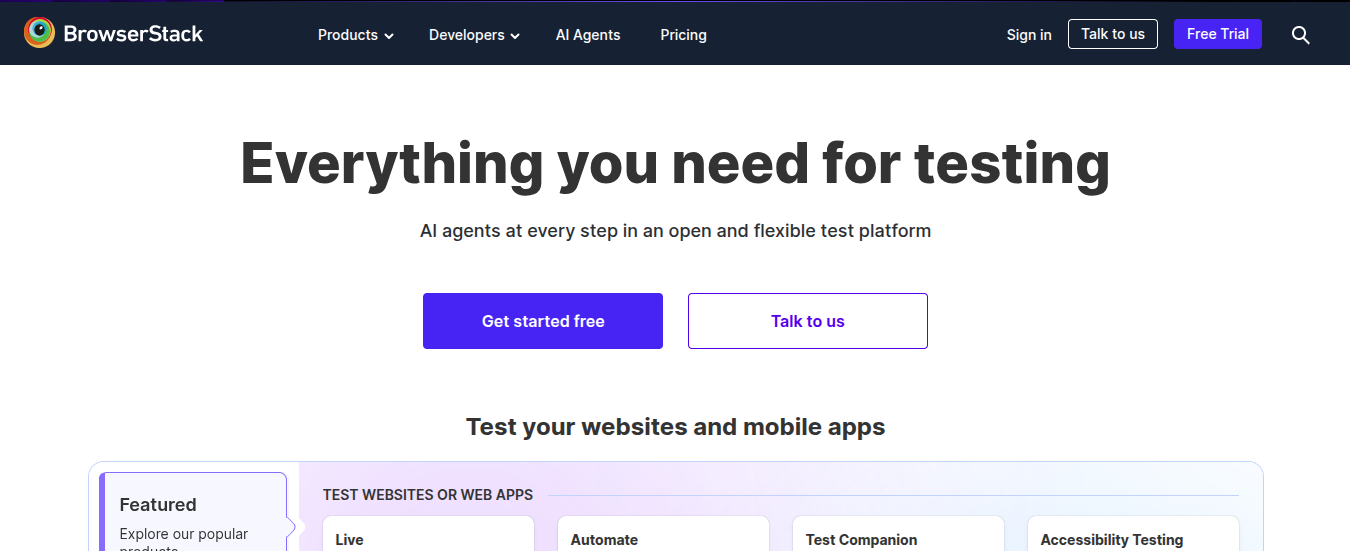
Where the gap is browsers and handsets rather than authoring, BrowserStack addresses it directly with 3,500 real devices, Automate and App Automate for execution, Percy for visual regression, and Live for interactive sessions.
It replaces infrastructure rather than the authoring layer, so it pairs with Playwright or Appium. Our BrowserStack alternatives guide compares the clouds.
Percy and Observability sit alongside for visual regression and flaky test detection, so parts of what a consolidated platform promised arrive here as separate products you adopt one at a time.
Pros: the broadest device and browser matrix, published pricing, mature support for every mainstream framework.
Cons: no authoring layer, so the plain-English question stays open.
Pricing: from $29 a month, scaling with concurrency.
Best for: teams whose constraint is coverage.
6. Is Appium a free testRigor alternative for mobile?
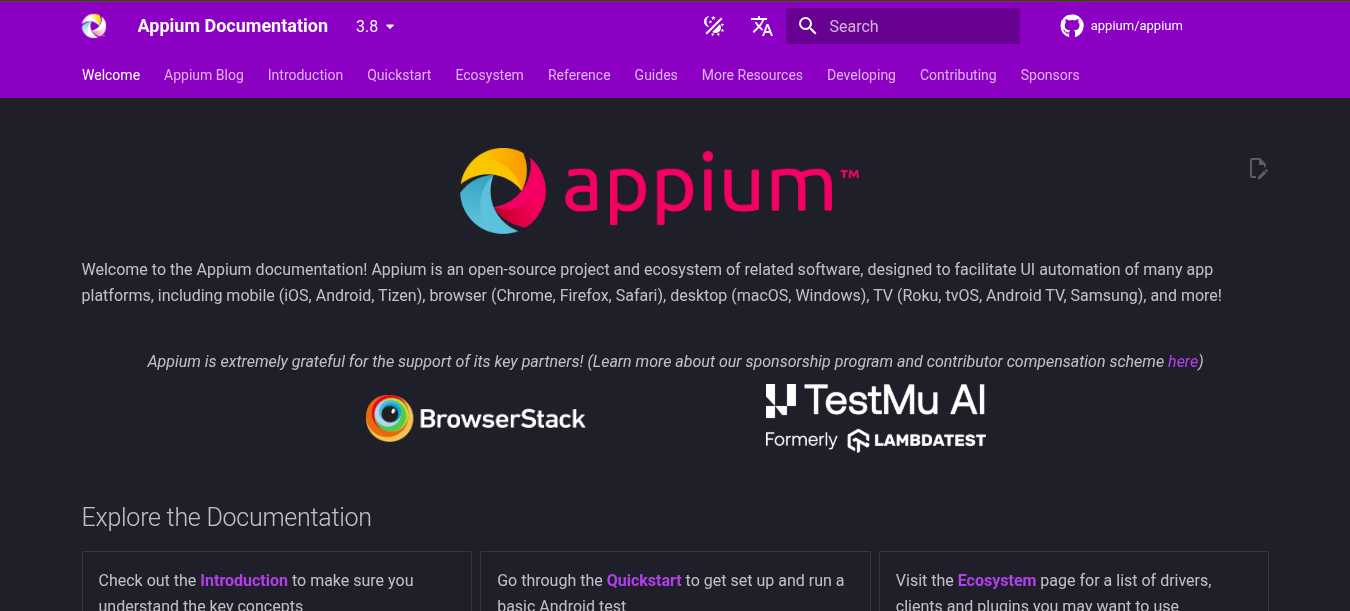
For the mobile half, Appium removes both the licence and the lock-in. It implements the W3C WebDriver specification in five languages and runs on any device cloud or your own hardware, so the suite travels with you rather than living in a vendor account.
What you take on is device provisioning, driver rebuilds after iOS releases and flake management. Our Appium guide covers the setup path.
Portability is the underrated part. Every major device cloud runs Appium natively, so the same suite executes on a laptop, on a rented fleet, or on your own rack unchanged, which is the structural opposite of a runtime-held test.
Teams that make this work usually have a platform engineer who owns the grid as a product. Where that role is missing, the grid quietly becomes the least reliable part of the pipeline.
Pros: free, language-agnostic, standards-based, tests live in git, portable across every device cloud.
Cons: verbose configuration, iOS driver maintenance, and it needs engineers, which is usually why testRigor was chosen.
Pricing: free, Apache 2.0.
Best for: mobile teams with engineering capacity.
7. Is Mabl a low-code testRigor alternative?
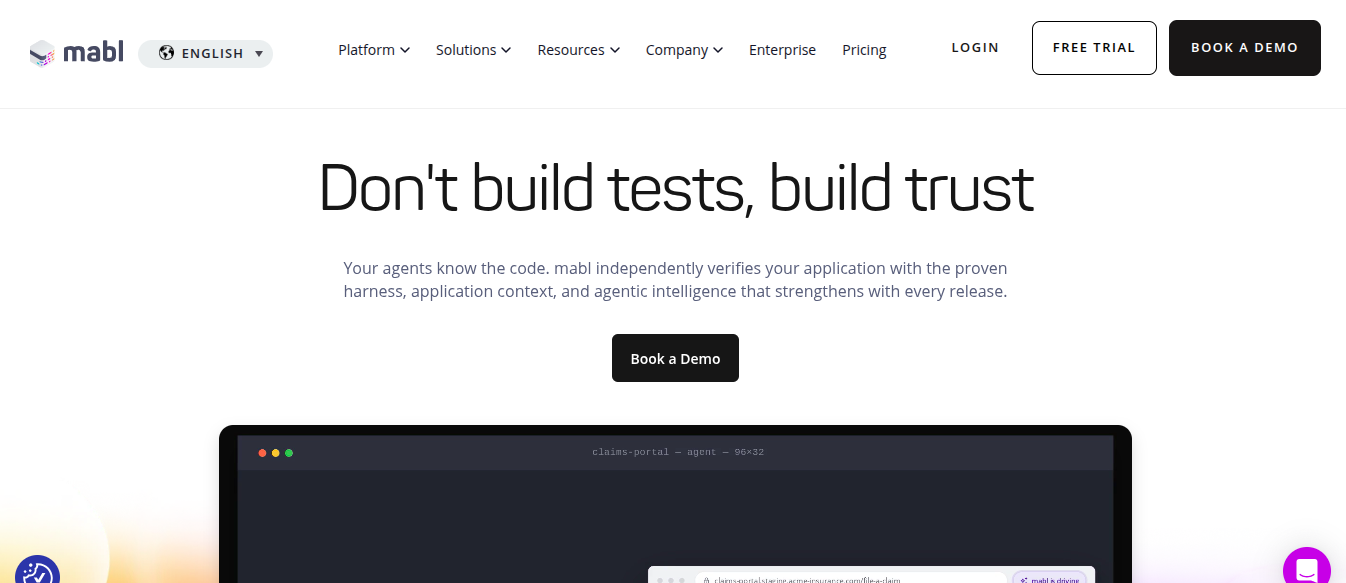
Mabl stays in the codeless lane with a visual builder rather than sentences. Its own pricing page describes one purchase spanning web, mobile, API, accessibility and performance testing, with unlimited test run concurrency and unlimited local and CI runs, and leads with Request a Quote.
Element identification works on behavioural properties rather than literal selectors, which is a different healing mechanism from a plain-English layer resolving intent at runtime.
Be clear that this answers the pricing and healing questions while leaving ownership untouched. Moving between two vendor runtimes changes who holds the tests rather than whether someone else does.
Pros: unlimited concurrency and local runs per its pricing page, ML-based healing, five surfaces, visual builder for non-engineers.
Cons: quoted pricing, closed-source, and the same runtime lock-in you may be leaving.
Pricing: request a quote.
Best for: teams staying codeless who prefer a builder to sentences.
Which testRigor constraint are you solving?
Your testers can code, or you can hire for it. Playwright. This is the recommendation practitioners themselves give, and the cost difference is the whole licence.
Your authors will never write code. Katalon for a recorder with published pricing, Mabl for a builder with healing, or BugRadar for natural language without a vendor runtime. All three keep the barrier low while differing on who ends up holding the tests.
Tests locked in a vendor runtime. Playwright or Appium put files in git, with branching, review and revert arriving for free. BugRadar's code-managed flows do the same for a natural-language surface.
Device and browser coverage. BrowserStack, keeping whatever framework you choose, which also makes the next migration cheaper because the tests travel with you rather than with the vendor.
Desktop, mainframe or 21 CFR Part 11. Stay. testRigor's own site lists those surfaces, and nothing on this list reaches them. A partial migration is usually right: move the web and mobile suites, leave the regulated and legacy coverage where it already works.
Conclusion
testRigor covers more ground than most plain-English tools, and for a regulated team testing mainframe alongside web, that breadth has few substitutes.
The decision that actually matters is about people. If your testers write code, almost everything here beats a no-code runtime on freedom, cost and portability. If they do not, the real question is whether to buy around that or hire for it, and that is a budget conversation rather than a tooling one. Answer it first, because every option below follows from it.
Frequently asked questions
What is the best testRigor alternative in 2026?
No universal winner. BugRadar for teams whose pain is the hidden Selenium layer and parser edge cases. Playwright for code-first control with auto-waiting. Cypress for JS/TS teams valuing time-travel debugging. Mabl for enterprise low-code with ML healing. Match the tool to the specific testRigor limitation driving the switch.
Does testRigor use Selenium under the hood?
Community reports confirm Selenium exceptions appear in testRigor's test logs. The plain-English authoring layer translates steps into Selenium-based execution. Selenium's failure modes (selector fragility, WebDriver session timeouts) can surface even though you never authored a selector directly.
Is testRigor actually free?
testRigor offers a free Public Open Source plan. The Private paid plan requires a 14-day trial signup, then transitions to pricing that is not published publicly. The /pricing page returns a 404. Paid rates are discovered during signup or on a sales call.
Can BugRadar replace testRigor for mobile testing?
For iOS and Android E2E flows, yes. BugRadar runs mobile apps by intent on virtual and physical devices with session replay on every PR. For mainframe, Windows desktop, or heavy API mocking, testRigor covers surfaces BugRadar does not target. If most of your testRigor scope is UI-driven mobile and web, BugRadar replaces it.
How does testRigor's MCP server differ from BugRadar's MCP server?
testRigor's MCP helps a coding agent write and maintain plain-English test scripts. BugRadar's MCP lets a coding agent run tests end-to-end against a PR and posts the verdict back. Same protocol, different job: authoring assistant versus execution runtime.
Is Playwright better than testRigor for engineering teams?
For teams that want full execution-layer visibility, deterministic debugging, and zero NLP grammar, Playwright is the stronger pick. testRigor wins for mixed-skill teams where business analysts author tests in plain English. The choice depends on who writes and maintains the tests.
What is the cheapest testRigor alternative?
Playwright, Cypress (core), WebdriverIO, and Appium are free and open source. Testsigma offers a free community edition. BugRadar offers a self-serve trial with transparent per-run pricing. Mabl and Functionize are enterprise-priced with sales-gated quotes.
Does testRigor integrate with CI/CD and coding agents?
Yes. testRigor ships an MCP server and a Claude Code Skills integration for test authoring in CI workflows. The distinction: testRigor's integrations help write tests, not execute them as an automated PR check. BugRadar's MCP runs tests on every PR and posts results directly to GitHub.