
Sauce Labs Alternatives in 2026: 7 Tools Compared by Which SKU They Replace
Sauce Labs alternatives compared: BrowserStack, LambdaTest, BugRadar, Playwright, Kobiton, Cypress and Appium. Pricing, which SKU each one replaces, and the free options.
- Written by
- Yuvan Sundrani
- Read time
- 16 min read
- Published
TL;DR
- BrowserStack is the closest like-for-like swap for the Real Device Cloud and the cross-browser grid.
- LambdaTest covers the same surface from a lower entry price, with natural-language authoring included.
- BugRadar is the one to look at when the AI authoring layer is what you actually came for.
- Playwright removes the script execution cloud entirely for web, free and open source.
- Kobiton suits regulated teams who need the device lab inside their own walls.
- Cypress is the front-end pick where debugging experience outranks device breadth.
- Appium is the free route if you have engineering time to run the infrastructure yourself.
Sauce Labs ships more than ten products under one enterprise contract: AURA, Real Device Cloud, Virtual Device Cloud, Live Testing, Sauce AI Test Authoring, Sauce Visual, Error Reporting, Mobile App Distribution and a hosted MCP server.
That breadth is a genuine strength for an enterprise QA org that uses all of it. It turns into friction the moment your team uses three SKUs and funds the other seven.
So the useful question is narrower than it first looks. Rather than hunting for one tool that replaces Sauce Labs, work out which SKU is generating your invoice, then swap that one.
Why move off Sauce Labs?
Pricing runs per parallel session, and the tiers stack: $39 a month for Live Testing, $149 for the Virtual Device Cloud, $199 for the Real Device Cloud. At meaningful concurrency, enterprise contracts commonly land between $30,000 and $120,000 a year, and the curve steepens faster than most teams budget for.
The second pressure is the Enterprise gate. AURA and Sauce AI Test Authoring ship on Enterprise contracts alone, so self-serve tiers get the grid while the AI layer stays locked. A r/QualityAssurance thread asking which AI QA tools people are genuinely using drew 39 votes and 126 comments, which is a fair measure of how actively teams are shopping that layer.
The third is fidelity, and it cuts both ways. A r/softwaretesting thread titled "Mobile emulation isn't catching real iOS/Safari issues" pulled 23 votes and 8 comments on exactly this point, and the long-running r/webdev rant "I can't stand developing for Safari anymore" sits at 2.8K votes and 528 comments. Real devices earn their cost here.
Here is the reframe worth holding onto: the alternative to Sauce Labs is a portfolio swap rather than a single product.
| Tool | What It Tests | Pricing | Best For |
|---|---|---|---|
| BrowserStack | Web and mobile, 3,500+ real devices | From $29/mo | Widest browser and device matrix |
| LambdaTest | Web and mobile, real device cloud | From $19/mo | Device breadth on a smaller budget |
| BugRadar | Native iOS and Android, plus web | Per agent-run, self-serve trial | Teams replacing the AI authoring layer |
| Playwright | Web (Chromium, Firefox, WebKit) | Free, Apache 2.0 | Dropping the execution cloud outright |
| Kobiton | Native iOS and Android, 7,000+ devices | Per device minute, custom | Private device labs and compliance |
| Cypress | Web (Chromium-based, Firefox, WebKit) | Free runner, Cloud paid | Front-end teams who debug in the browser |
| Appium | Native iOS and Android | Free, Apache 2.0 | Direct device control with no vendor tie |
1. Is BrowserStack a good Sauce Labs alternative?
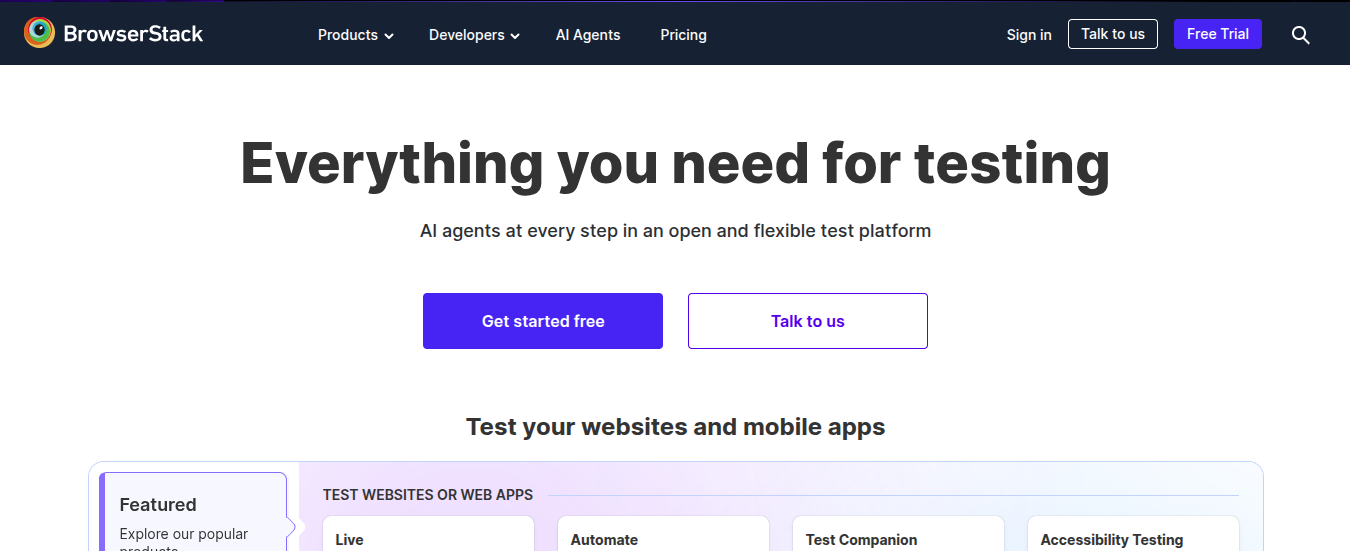
BrowserStack maps almost one to one onto the Sauce Labs Real Device Cloud and cross-browser grid. It carries 3,500 real devices, runs Selenium, Appium, Playwright and Cypress scripts through Automate, and offers Live for manual sessions. App Live, App Automate and Accessibility Testing sit alongside as separate products.
The catch is that BrowserStack prices per parallel session too, so the scaling curve you are escaping reappears in a different colour. Teams weighing the two usually decide on tier fit rather than capability. Our BrowserStack alternatives guide walks the same arithmetic from the other direction.
Where BrowserStack genuinely pulls ahead is the manual side. App Live and Live give a tester an interactive session on a real handset in a few seconds, which matters for exploratory work and for reproducing a customer report on the exact OS build they reported it on.
Pros: widest device and browser matrix, mature framework support, strong documentation.
Cons: per-parallel pricing scales the same way Sauce Labs does, and the AI features trail AURA.
Pricing: from $29 a month for Live, with Automate tiers scaling on concurrency.
Best for: teams who want the breadth and accept the pricing model.
2. Does LambdaTest cost less than Sauce Labs?
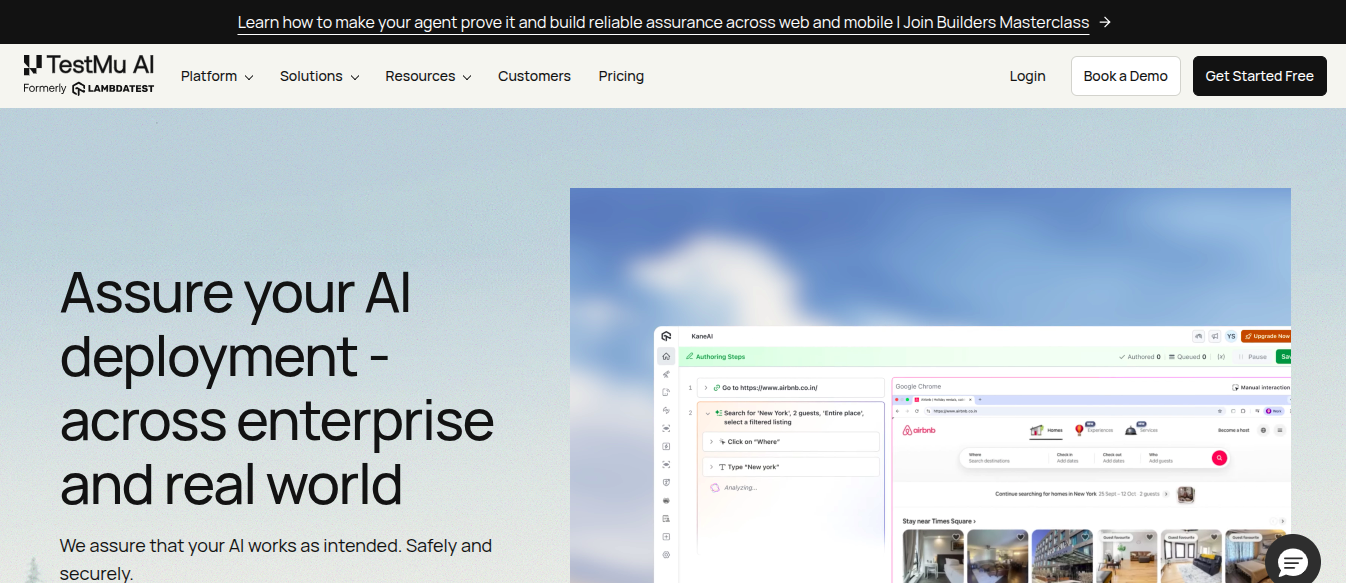
LambdaTest reaches most of the same ground from a lower floor. Real device cloud, browser testing and KaneAI natural-language authoring run across tiers rather than sitting behind an enterprise gate, which is the specific thing Sauce AI does.
That tier structure is the reason LambdaTest shows up so often in Sauce Labs evaluations. A team that wants to keep its existing Selenium or Appium suite, keep real device coverage, and still try AI authoring can do all three on a mid-tier plan. On Sauce Labs the same combination requires an Enterprise conversation.
The trade-off arrives at the top of the range. Device inventory is smaller, the newest flagship handsets land later, and support for audited industries is thinner than the incumbents offer. For a team of ten shipping a consumer app, none of that bites. For a bank with a device certification matrix, it does.
Pros: lowest entry price of the major clouds, natural-language authoring included, broad browser coverage.
Cons: smaller real device inventory than Sauce Labs or BrowserStack, and thinner enterprise support for regulated industries.
Pricing: from $19 a month per parallel session.
Best for: budget-conscious teams who want device infrastructure plus AI authoring together.
3. Is BugRadar a Sauce Labs alternative for AI test authoring?
Here is the honest pivot. If your Sauce Labs spend is the device cloud, BrowserStack or LambdaTest replaces it more directly than anything else on this list, and you should pick one of those. Plenty of teams searching for a Sauce Labs alternative are chasing AURA rather than devices, and that is a different problem.
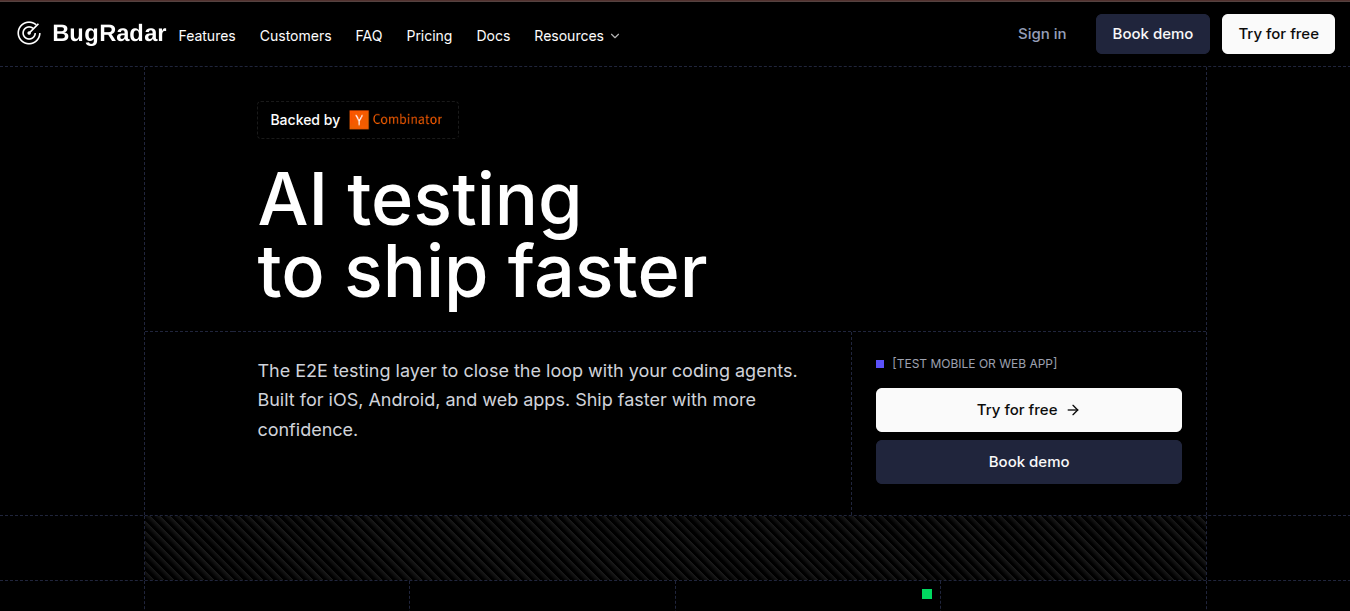
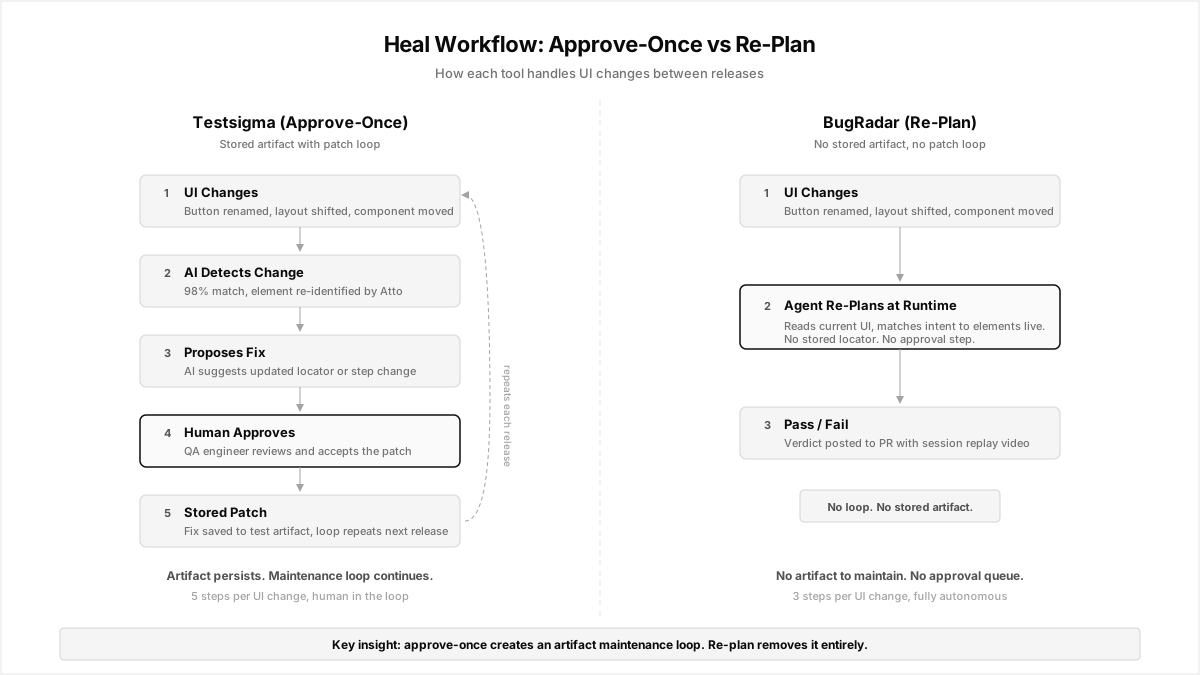
BugRadar is an AI-native E2E testing agent for iOS, Android and web. Instead of generating a script artifact from intent, the agent runs the flow against the current UI on every execution. There is no stored test to heal, because there is no stored test. You describe the flow in plain language, and the agent decides at runtime which element matches that intent.
It ships an MCP server that runs flows end to end on pull requests. A coding agent invokes MCP, BugRadar reads the diff, runs the flow across iOS and Android builds and web on virtual and physical iOS and Android devices, then posts a video and a verdict through the GitHub integration.
Pros: no script artifact to maintain, intent survives UI refactors, MCP support for Claude Code, Cursor, Codex and Devin, available on a self-serve trial rather than an enterprise contract.
Cons: it is the agent rather than the infrastructure, so visual regression, crash analytics and beta distribution stay elsewhere.
Pricing: per agent-run, with no per-parallel-session or seat fees.
Best for: teams replacing AURA, and teams whose coding agents need the testing half of the loop.
4. Can Playwright replace Sauce Labs for web testing?
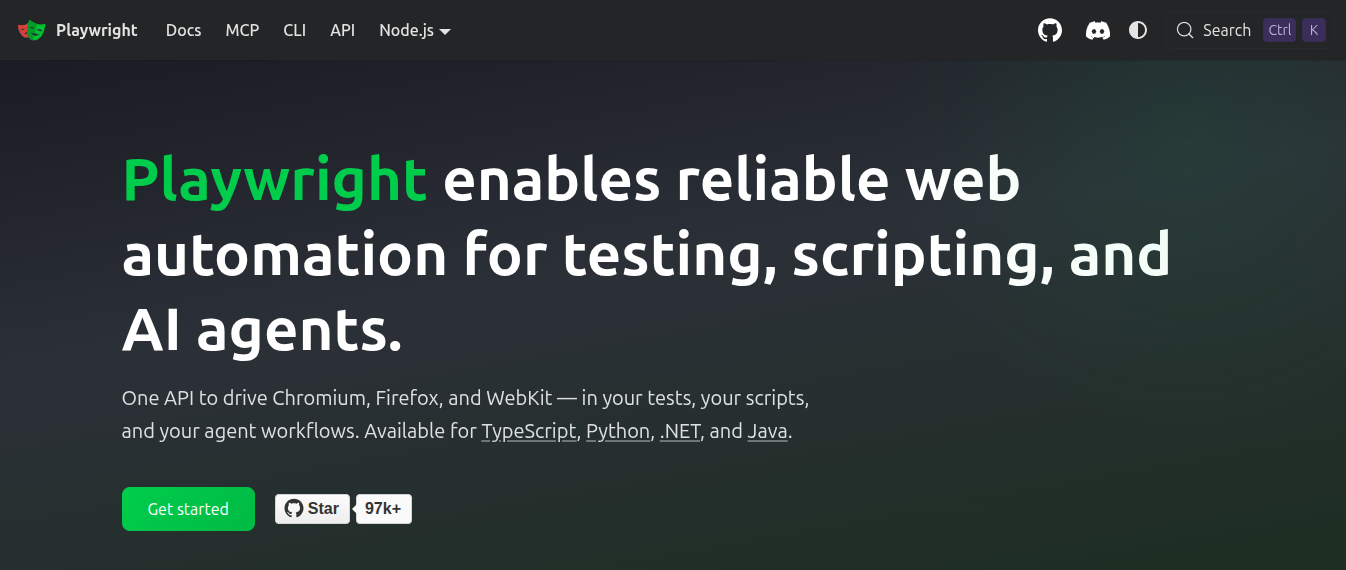
Playwright is Microsoft's open-source framework built on the DevTools protocol. One API covers Chromium, Firefox and WebKit, with auto-waiting, native parallelism and bindings for JavaScript, TypeScript, Python, Java and C#. Run it in your own GitHub Actions or GitLab CI and the per-parallel-session fee disappears along with the vendor.
The auto-waiting model deserves a specific mention, because it addresses the single largest source of flake in cloud-run suites. Playwright waits for an element to be actionable rather than merely present, which removes most of the arbitrary sleep statements that accumulate in older Selenium code. Trace viewer then records every step with a DOM snapshot, so a CI failure comes back with the same debugging surface a paid dashboard would give you.
What you take on in exchange is infrastructure. Browser version management, container orchestration and runner capacity all become yours, and the engineering hours that absorbs are the honest counterweight to the licence saving.
Pros: free, fast, genuinely cross-browser, and the auto-waiting model removes a whole class of flake.
Cons: selector-based underneath, viewport emulation rather than real mobile devices, and you own the CI infrastructure.
Pricing: free, Apache 2.0.
Best for: code-first web teams leaving the cloud behind.
5. Is Kobiton better than Sauce Labs for private device labs?
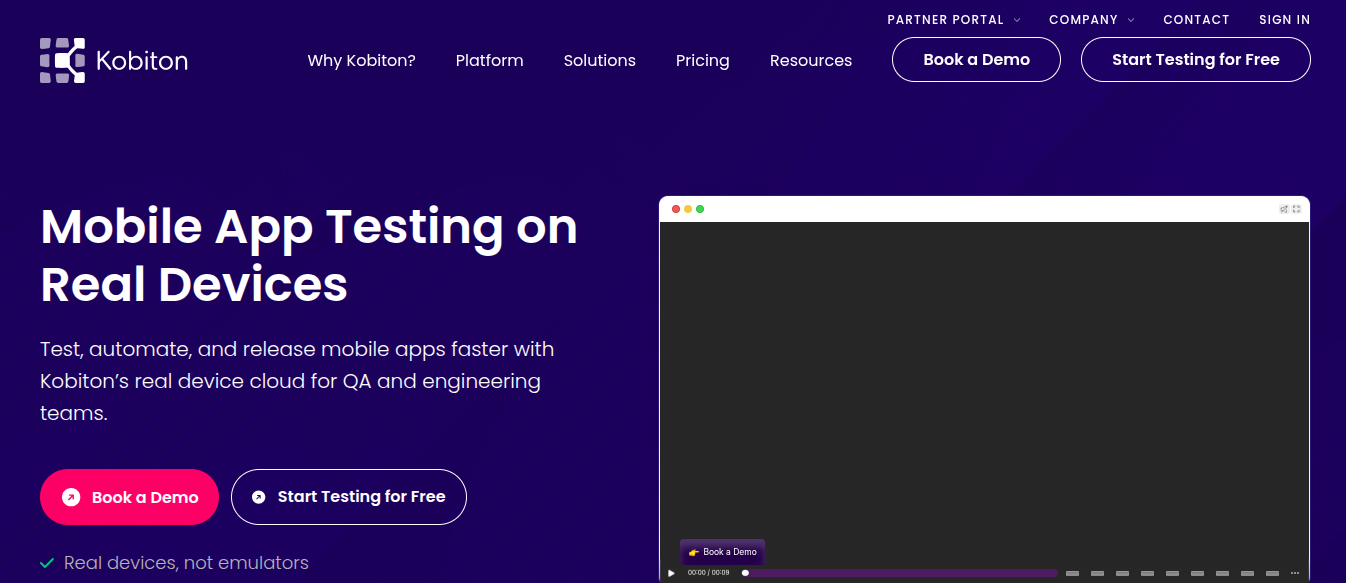
Kobiton concentrates on mobile device clouds with private labs and compliance as the headline. Finance, healthcare and government teams pick it for on-premises hosting, scriptless capture and granular device controls that a shared cloud cannot offer.
Whether to run your own hardware is a live argument. A r/QualityAssurance thread asking whether maintaining your own Android emulator infrastructure is worth it drew 9 votes and 14 comments, and the replies split along exactly the control-versus-overhead line. Our Kobiton alternatives guide covers the same ground for teams already on it.
Scriptless capture is the other draw. A manual tester records a session on a real handset and Kobiton converts it into a replayable Appium script, which gives a QA team with limited automation experience a path into automated coverage. The generated scripts still need review before they go near a pipeline, so treat it as a starting point rather than a finished suite.
Pros: private and on-premises hosting, compliance controls, scriptless capture.
Cons: narrower web and browser coverage, and custom contracts make the cost hard to compare.
Pricing: per device minute, custom.
Best for: regulated teams who need the devices inside their own perimeter.
6. Can Cypress replace Sauce Labs for front-end testing?
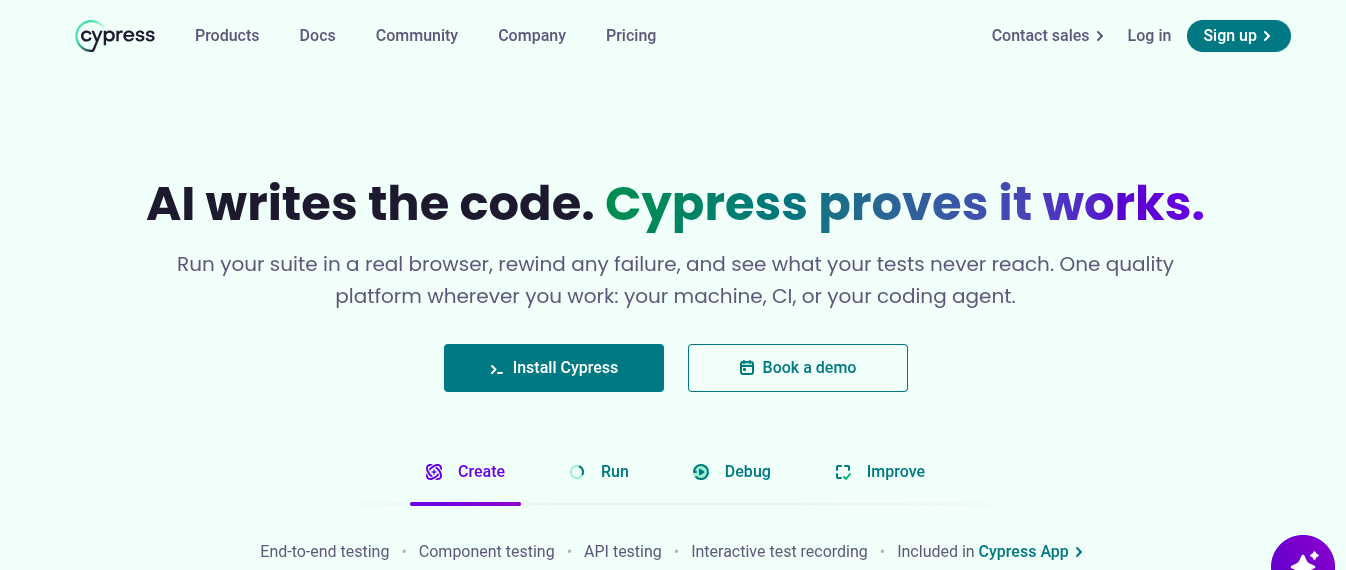
Cypress runs inside the browser event loop and gives you time-travel debugging with a DOM snapshot at every step. For a JavaScript or TypeScript front-end team, Cypress in CI covers the Sauce Labs script execution surface, and Cypress Cloud adds parallelism, dashboards and flake detection on top.
Time-travel debugging is the feature people stay for. Hovering a step in the command log restores the application to that exact moment, which turns a failing assertion into a five-second diagnosis rather than a reproduction exercise. For teams whose failures are mostly front-end logic rather than device behaviour, that loop beats anything a remote cloud session offers.
The boundary is equally clear. Cypress tests the web, and a team shipping a native iOS or Android app alongside the site will still need a second tool for the mobile half.
Pros: the best debugging experience in the category, fast feedback, strong front-end ergonomics.
Cons: JavaScript and TypeScript alone, no native mobile, and cross-origin or multi-tab flows stay awkward. Parallel runs need the paid Cloud tier.
Pricing: free runner under MIT, with Cypress Cloud paid.
Best for: front-end teams who debug in the browser.
7. Is Appium a free Sauce Labs alternative for mobile testing?
Appium is the open-source mobile automation framework the Sauce Labs founders helped create, and the Real Device Cloud is substantially Appium execution at scale. Run it yourself and you replace the execution layer while keeping full control of device configuration and orchestration, as set out in the W3C WebDriver specification it implements.
The overhead is real, and people are candid about it. A r/QualityAssurance thread asking for tips on maintaining your own Selenium grid holds 9 votes and 17 comments of hard-won advice about the parts nobody budgets for. For a wider view of the mobile field, our mobile testing tools roundup compares the options side by side.
Teams that make this work usually have a platform engineer who owns the grid as a product rather than a side task. Where that role exists, the saving is substantial and the control is genuine. Where it does not, the grid quietly becomes the flakiest part of the pipeline.
Pros: free, language-agnostic, total control, and no vendor dependency whatsoever.
Cons: you own the infrastructure, WebDriverAgent rebuilds on iOS updates, and capability configuration is verbose.
Pricing: free, Apache 2.0.
Best for: teams with the engineering time to run their own grid.
Which Sauce Labs SKU should you keep?
Several of them, probably. The decision is per product rather than per vendor.
Real Device Cloud. Keep it where day-zero flagship access and private labs are hard requirements. Swap to BrowserStack for breadth, LambdaTest for cost, or Kobiton for compliance. Swap to Appium plus your own hardware where vendor independence matters more than convenience.
Virtual Device Cloud. Where you only run emulator and simulator tests, Playwright or Cypress in CI covers it. The cloud adds convenience here rather than capability.
Script execution. Moving Selenium or Playwright runs into your own pipeline removes the per-parallel fee outright. Keep Sauce Labs where your triage process leans on its artifact logging and session replay.
AI Test Authoring and AURA. Keep it where the closed-loop workflow already fits your release process and the Enterprise contract is signed. Swap to BugRadar where you want intent-based execution on a self-serve trial.
Sauce Visual and Error Reporting. Keep both, or move them to Percy, Applitools, Sentry or Datadog. Nothing on this list targets those surfaces.
Most teams land somewhere in the middle: keep the SKUs that earn their cost, and buy the rest from tools built specifically for the job.
Conclusion
Sauce Labs rarely loses on capability. It loses on shape: ten products under one contract, priced per parallel session, with the AI layer locked behind an enterprise signature. Teams leave when the bill stops matching the usage rather than when the platform stops working.
Audit which SKUs you genuinely touch before you shop. Most discover they are funding a ten-product platform to solve a three-tool problem, and the cheapest route out keeps the surface that earns its cost while buying the rest elsewhere.
Frequently asked questions
What is the best alternative to Sauce Labs in 2026?
It depends which SKU is costing you. BrowserStack and LambdaTest replace the device cloud, Playwright and Cypress replace script execution, BugRadar replaces AI authoring, and Appium gives you free mobile automation. Match the tool to the invoice line.
Is Sauce Labs worth it for small teams?
Entry sits at $39 a month for Live Testing, though most teams need the $149 Virtual or $199 Real Device tier, and Sauce AI needs an Enterprise contract. Under five parallel sessions, Playwright in CI or a lower LambdaTest tier usually delivers comparable value for less.
What is the cheapest Sauce Labs alternative for real device testing?
LambdaTest starts at $19 a month per parallel session and BrowserStack at $29, both well under the $199 Real Device Cloud tier. Appium costs nothing in licence fees, though you supply the hardware.
Does Playwright replace the whole Sauce Labs platform?
For web script execution, yes, and the per-parallel fee goes with it. Real device mobile testing, visual regression, crash analytics and beta distribution all sit outside its scope, so it replaces one layer rather than the platform.
Does Sauce Labs have a free tier?
There is a free trial via signup rather than a published free tier. Paid plans begin at $39 a month annually for Live Testing, $149 for the Virtual Device Cloud and $199 for the Real Device Cloud, with AURA priced on custom Enterprise contracts.
What is Sauce Labs AURA?
AURA is the AI-Unified Release Assurance Platform, an autonomous system that authors, runs and analyses tests from business intent. It is Enterprise-tier only. BugRadar and LambdaTest's KaneAI both offer AI authoring below that gate.
Is BrowserStack better than Sauce Labs?
Both price per parallel session with comparable coverage, and BrowserStack's entry tier runs slightly lower. Sauce Labs counters with AURA and a hosted MCP server. The honest answer is that tier fit decides it rather than any categorical advantage.
Can BugRadar replace Sauce Labs for mobile testing?
For iOS and Android flows run by intent, yes, on virtual and physical iOS and Android devices with the GitHub Bot running the relevant flows on pull requests and per-agent-run pricing. The 10,000-device private cloud, Sauce Visual, Error Reporting and App Distribution stay where they are.